


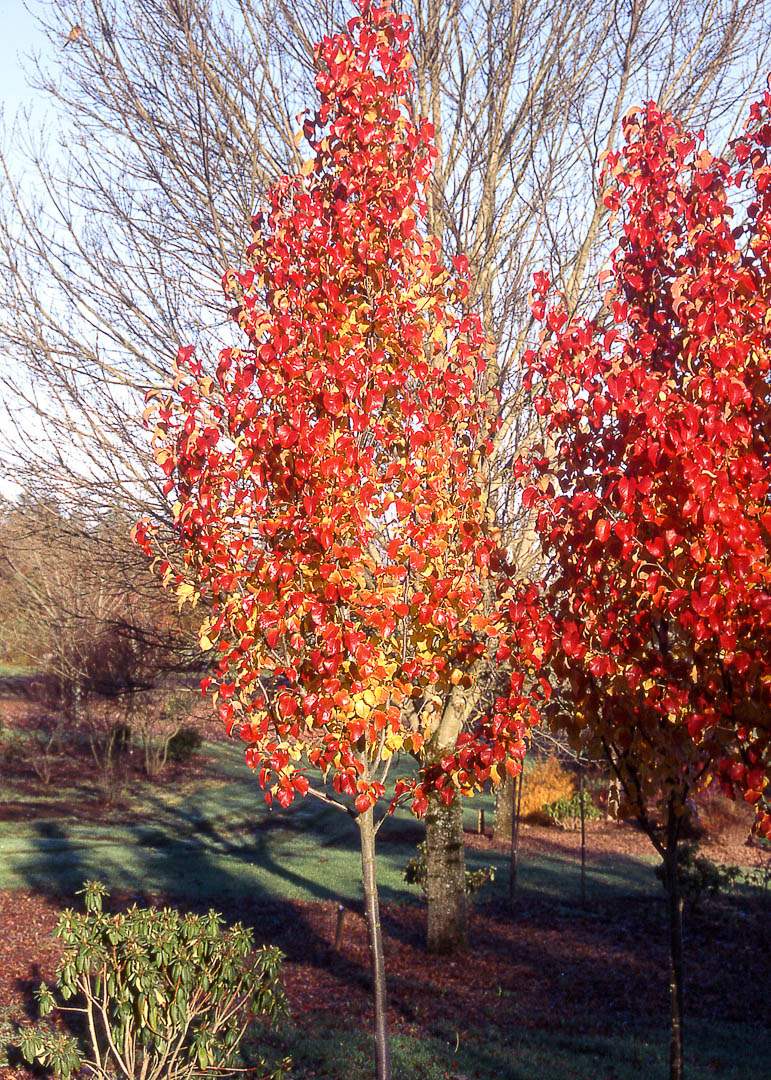
Callery pear, sold as Bradford and under a handful of other cultivar names, is one of the most widely planted ornamental trees in the country and it earned that the honest way. It grows quickly, holds a tidy symmetrical form with no pruning at all, covers itself in white flower before almost anything else opens, colours well in fall, and tolerates poor soil, compaction and neglect.
What it does not do is hold itself together at maturity. The branches come off the trunk at very narrow angles, and several of them often crowd out of nearly the same point. In a union that tight, bark gets pinched between the branch and the trunk instead of wood growing together — so the joint looks solid and is not. Somewhere around fifteen to twenty years, a wind event or a heavy wet snow finds that weakness, and the tree splits. Often it takes a third of the canopy. Sometimes it goes down the middle and the tree is finished.
This is not a defect you discover late and then manage. It is built into how the tree grows, and by the time you can see it the branches are too large to correct.
It is, however, preventable — early. Structural pruning in the first five to eight years, while the competing leaders are still finger-thick, produces a fundamentally different tree at twenty. Take out the rival leaders, open the tightest unions, and establish one dominant trunk before the tree decides for itself. It is a small job done on a schedule and it is the whole difference.
We will plant one and we will put that pruning on the schedule with it. If you would rather not carry a maintenance commitment on an ornamental tree, hawthorn and serviceberry give you spring flower, fall colour and fruit for the birds on this ground, with structure that looks after itself.