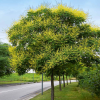
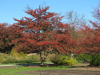
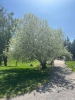
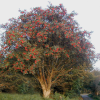
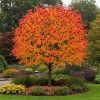
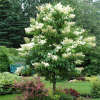
An ornamental tree is defined by scale before anything else. Under about twenty-five feet at maturity, which sounds like a limitation and is the entire point — it is what makes them the right tree for all the places a shade tree cannot go.
The clearest case is a power line. A large tree under wires will eventually be topped by the utility, and a topped tree is finished: the structure is gone, the regrowth is weak and badly attached, and it never looks right again. Anything under the lines should be a tree that never reaches them. That single constraint decides more front-yard plantings in this valley than any aesthetic preference does.
The same logic applies near a foundation, in a courtyard, beside an entry, between a walk and a drive, or anywhere the canopy has somewhere it is not allowed to go. And within that constraint the list is the most interesting one we carry — this is where the spring flowering, the fall colour, the berries and the winter bark live.
Most of this list is one plant family, and that matters
Crabapple, hawthorn, mountain ash, serviceberry and ornamental pear are all in the rose family, along with every apple, pear, plum and cherry. Family is usually an academic detail. Here it is practical, because disease runs along family lines.
Two things move through that group in this county. Fire blight is a bacterial infection that moves fast in a warm wet spring — shoot tips blacken and curl over like a shepherd's crook, and it can take large limbs in a season. Cedar-apple rust needs a juniper and a rose-family host within about a mile of each other and shuttles between them year after year, spotting leaves and weakening the tree.
Neither is a reason to avoid these trees — they are among the best small trees available here. It is a reason to look at what is already on the property before planting a row of them, to choose resistant varieties where the pressure is real, and to know that a crabapple by the drive and an apple orchard down the road are part of the same conversation. Fruit trees covers the other end of it.
Check what is underneath before you check the flowers
Several of the best ornamentals fruit, and fruit falls. A crabapple or a mulberry in a border is a good decision; the same tree over a patio, a walk, a drive or a parking space means a few weeks of stain, wasps and a slick surface every autumn for the life of the tree.
Look at what is under the canopy before choosing the tree. It is the easiest mistake to avoid and one of the most annoying to live with.
One form question worth asking early
Many of these are available as either a single-trunk tree or a multi-stem clump, and they are different plants in a design. Single-stem reads formal and lifts the canopy for walking under. Multi-stem is wider, lower and more naturalistic, and it usually reads better against a house or in a bed. Decide which before ordering — it is not something that can be changed later.
And one tree we will sell you with a caveat
Ornamental pear — usually sold as Bradford or under one of the other Callery cultivars — is on this list, and it got planted across the country by the million for good reasons. It grows fast, holds a neat symmetrical shape without being pruned into one, flowers heavily and early, and tolerates poor soil and neglect.
It also has a structural problem that shows up around year fifteen or twenty. The branches leave the trunk at very tight angles, often several of them crowding out of nearly the same point, and bark gets trapped in those tight unions instead of wood knitting together. Those joints are weak. A mature Callery pear caught by a wind event or a heavy wet snow frequently splits — sometimes losing a third of the canopy, sometimes straight down the middle, and usually beyond saving.
The good news is that this is largely preventable, and preventable early. Structural pruning in the first five to eight years — taking out competing leaders while they are finger-thick and thinning the tightest unions before they get big — produces a very different tree at twenty. It costs little and it has to happen before the problem is visible, which is why it almost never happens.
So we will plant one, and we will tell you it needs that pruning and put it on the schedule. If you would rather not take that on, hawthorn and serviceberry give you spring flower and four-season interest on this ground with better structure and no such conversation. Both are on the list above.
Request an Estimate or call 970-835-9661