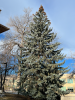
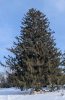
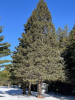
A spruce is the tree most people picture when they picture a conifer: dense, symmetrical, stiff-needled, holding a perfect cone shape from the ground up. Colorado blue spruce is the state tree and it is genuinely native here.
Which is exactly where the trouble starts. Native to Colorado does not mean native to a 5,000-foot valley floor. Blue spruce grows wild in cool, moist mountain drainages between roughly 6,000 and 11,000 feet — along streams, in the bottoms, where its shallow roots find steady water all season. That is not the site conditions of an open, sunny lawn in Delta, and the tree knows the difference even when the buyer does not.
Planted somewhere that suits it, a spruce is superb and long-lived. Planted in a hot, dry, exposed spot because it is native and therefore assumed tough, it spends fifteen years looking acceptable and then starts dying from the bottom up.
Here is what we carry.
Cytospora, and why lower branches die first
If you have seen an older blue spruce in this area with dead branches at the bottom and healthy growth up top, sometimes with a sticky white-grey resin bleeding down the trunk, that is cytospora canker. It is the most common serious problem on spruce in this region and it is essentially a disease of stressed trees.
It is not curable. Infected branches get removed and the tree carries on for years, often decades, but the shape is permanently changed and it works upward over time. Trees usually begin showing it around fifteen to twenty years old, which is long enough that nobody connects it to how the tree was sited and watered when it went in.
So everything useful here happens at planting and in the watering can:
- Water like it is a mountain streamside tree, because it is one. Spruce is the least drought-tolerant conifer we sell.
- Give it room and air. Crowded spruces with no air movement between them hold moisture on the foliage and stress each other.
- Do not wound the trunk. String trimmers and mower decks at the base are a common entry point.
- Avoid the hottest, most exposed corner of a property. That site wants a pine or a fir.
If the site is wrong for spruce, say so before you buy one
Somebody who wants the blue spruce look on a hot, dry site is usually better served by a white fir — the colour is comparable, the form is softer and more graceful, and it takes heat and drought considerably better without the cytospora history. It is the single most useful substitution in this catalog and almost nobody asks for it by name.
Request an Estimate or call 970-835-9661