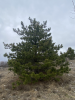
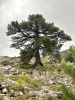
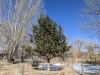
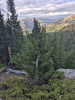
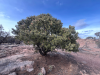
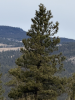
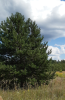
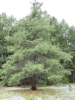
If one group of conifers belongs on the Western Slope, it is the pines. They root deep rather than wide, they handle alkaline soil without going chlorotic, and once a pine is established it will go through a dry summer that would set a spruce back badly. Most of the best windbreak and screening trees on this list are here.
Telling them apart is easier than it looks. Pines carry their needles in bundles, and the number in a bundle is the identification. Two to a bundle on Austrian, Scotch, Bosnian and piñon; usually three on ponderosa; five on limber, bristlecone and southwestern white. Pull one bundle and count — it narrows the field in a second, and it is the first thing anybody who works with conifers learns.
Here is what we stock and plant.
The thing that actually kills pines here is not drought
It is beetles, and beetles follow drought stress. That distinction matters because it is the difference between a problem you can prevent and one you cannot.
A healthy pine pushes out attacking bark beetles with resin. A pine that has been short of water for a season or two cannot produce enough pitch to do it, and the beetles get in. This is not theoretical here — the drought in the early 2000s put enormous numbers of piñon under stress across this part of the state, ips beetles moved into the weakened trees, and whole hillsides of piñon went red and died within a couple of years. The healthy, watered trees in town largely came through it.
Which makes supplemental water the single most effective beetle control there is, and it is worth understanding the timing. A mature pine is not a shrub — it wants a deep, slow soak out at the drip line a few times through a dry summer, not a daily sprinkle at the trunk. And it wants water in a dry winter too, on a warm day when the ground has thawed. Two or three deep waterings in a drought year is not much, and it is most of what stands between a pine and the beetles.
If you have pines on your property and have not watered them because pines are drought-tolerant, that is the thing worth changing. Drought-tolerant means they survive a dry spell. It does not mean they survive several in a row with a beetle flight in the middle.
Request an Estimate or call 970-835-9661