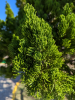
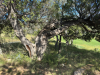
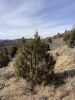
If a site has defeated everything else, a juniper will probably grow there. They tolerate alkaline soil without complaint, they are genuinely drought-hardy once established, they take wind, they root in ground that barely qualifies as soil, and deer mostly leave them alone. Several of them are native to exactly this country — you can see them on the mesas and the dry benches without anybody having planted or watered them.
That toughness makes them the backbone of low-water planting here. Where a spruce needs a favourable site and regular water, a juniper needs neither, which is why they end up along driveways, on slopes, in windbreaks and on the hot exposed corners where nothing else held.
The trees are below. The genus runs much wider than this page — junipers range from forty-foot trees down to groundcovers six inches tall that spread eight feet, and the shrub and groundcover forms are in their own categories.
One caution, and it matters in this county
Junipers are the alternate host for cedar-apple rust and its relatives. The fungus cannot complete its life cycle on either host alone — it needs a juniper and an apple, crabapple or hawthorn within roughly a mile of each other, and it moves back and forth between them year after year.
On the juniper it is mostly cosmetic: odd brown galls that swell and put out bright orange gelatinous horns after a wet spring, alarming to look at and largely harmless to the tree. On the apple it is not cosmetic. It spots the leaves, weakens the tree and can mark the fruit.
In a county with this much orchard in it, that is worth a moment's thought before a juniper windbreak goes in. It runs both directions — if you are planting apples, what is already in the fencerows matters too. It is not a reason to avoid junipers, which are among the best-adapted plants available here. It is a reason to look around first, and to mention it to a neighbour with an orchard rather than have them work it out later.
What they ask for
Very little, and that is the point. Two seasons of establishment water like anything else, then largely left alone. The most common way to kill an established juniper here is overwatering it — a juniper on a lawn irrigation schedule in heavy ground sits wet and rots, and it dies looking overwatered rather than dry.
Request an Estimate or call 970-835-9661