Firs get asked for less often than pine or spruce, and on most Western Slope sites at least one of them is the better tree.
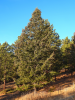
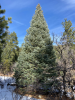
White fir — also sold as concolor fir — is the one worth knowing about. It has the soft blue-grey colour people want from a blue spruce, in longer, softer, flatter needles that are pleasant to stand next to rather than sharp. It grows into an elegant, slightly open pyramid instead of a dense cone. And it handles heat, drought and alkaline ground substantially better than blue spruce, without the cytospora history that follows spruce around this region.
The other is Douglas fir, which is not a true fir at all — it is Pseudotsuga, its own genus, and the common name has been misleading people for a century. It is a fine tree on a cooler, moister site with decent drainage, and it is the less adaptable of the two on an exposed valley-floor property.
Both want better drainage than a spruce will tolerate. Neither wants to sit in heavy wet ground.
The substitution worth knowing about
The most common large-conifer request we get is some version of "a blue spruce." Often the site is a hot, open, south or west exposure on dry ground — which is close to the worst place to put one.
White fir answers that request better than a blue spruce does. Similar colour, softer texture, a more graceful form, and a tree far more likely to still look good in thirty years on that particular spot. It costs about the same and nobody ever asks for it, because it is not the tree everybody grew up hearing about.
That is most of what this page exists to say. If you are picturing a big blue-grey conifer for an open yard, look at white fir before you settle on spruce.
What both firs need
Drainage, first. A fir in heavy ground that holds water after a storm is a fir with a root problem coming, and that is true even of the tough one. If the ground is slow, plant high — on a graded berm or a raised bed — rather than amending a hole.
Then the usual two seasons of establishment water, deep and at the drip line, before either of them is asked to be drought-tolerant.
Request an Estimate or call 970-835-9661